

Summary:
Navigating the financial landscape of annuities becomes clearer with the present value of annuity calculator. This tool illuminates the current worth of future payments, factoring in elements like interest rates and time periods. Central to this is the time value of money concept, emphasizing that today’s dollar holds more value than tomorrow’s. Annuities, whether ordinary or due, offer predictable income streams, especially vital for retirees. By understanding the nuances of discounting, inflation impact, and the difference between present and future values, individuals can make informed decisions. Practical scenarios and real-world testimonials further underscore the calculator’s significance in financial planning.
Introduction
Imagine you’re on the brink of retirement, and you’re handed a crystal ball that reveals the value of your future annuity payments in today’s terms. Sounds magical, right? Welcome to the world of the Present Value of Annuity Calculator! This powerful tool is your gateway to understanding how much your future annuity payments are worth in today’s dollars. Whether you’re planning your retirement income, assessing your financial security, or making informed decisions about various annuity options, understanding the present value is crucial. As you embark on this financial journey, we’ll guide you from being a novice to a pro in harnessing the calculator’s potential.
1. What is an Annuity?
Imagine you’re on a serene beach, the sun setting in the horizon, and the waves gently lapping at your feet. As you sip on your favorite drink, you ponder about the steady flow of income that allows you this luxury in retirement. This is the magic of annuities.
A. Present Value of Annuity Calculator.
The present value of an annuity unveils the current worth of your future annuity payments, factoring in a specified rate of return or discount rate. In essence, it’s a bridge connecting your financial present to a secure future.
By understanding this value, you’re not just looking at numbers; you’re peering into a future where your financial decisions today ripple into long-term benefits.
This tool, rooted in the time value of money concept, emphasizes that a dollar today holds more “value” in its purchasing power than the same dollar in the future.
B. Definition and the Difference Between Annuities and Regular Payments
Think of an annuity as a safety net, ensuring you never outlive your savings. While regular payments, like your monthly salary, have an end date, annuities can offer a lifelong promise. You invest in an annuity either through monthly premiums or a lump-sum payment, and in return, you receive periodic payments in the future, either for a set period or for life.
C. Distinguishing Between Ordinary Annuities and Annuities Due
Annuities are available in different varieties. The main categories are ordinary annuities and annuities due. For ordinary annuities, payments are dispensed at the conclusion of each interval, whether it’s monthly, every quarter, or yearly.
On the other hand, annuities due require payments at the beginning of each period. It’s like choosing between two delicious ice cream flavors, each with its unique taste and benefits.
2. The Time Value of Money Concept
Imagine you’ve stumbled upon a magical lamp, and the genie inside offers you a choice: receive $10,000 today or the same amount five years from now. Which would you choose? Most would instinctively opt for the money today, and there’s a financial principle that explains why.
A. The Principle That Money’s Value Changes Over Time
The time value of money is a fundamental concept in finance that asserts money available today is worth more than the same amount in the future. Why? Because of its potential growth and earning power. If you invest $100 today, that money can start earning interest or dividends, making its future value more than the initial $100. This principle is rooted in the potential earning capacity of money, emphasizing that a dollar today holds more “value” in its purchasing power than the same dollar in the future.
B. How Inflation Impacts the Value of Money
But there’s another side to this coin: inflation. Inflation is the gradual increase in the prices of goods and services over time, effectively decreasing the number of items you can buy with a dollar in the future compared to today. For instance, if an apple costs $1 today, it might cost $2 a year from now, reducing your purchasing power. Inflation erodes the value of money, making it imperative to understand and plan for it.
In the grand scheme of financial planning, understanding the time value of money and the impact of inflation is like having a compass, guiding you through the complexities of investment decisions.
3. Present Value of Annuity: A Deep Dive
Picture yourself as a seasoned sailor, navigating the vast ocean of financial planning. The waves represent your future payments, and the compass in your hand? That’s the Present Value of Annuity.
A. Factors that Influence the Present Value: Payment Amount, Interest Rate, and Number of Periods
Like the varying winds that influence a ship’s course, several factors impact the present value of an annuity. The amount of each payment (PMT), the discount rate (r), and the number of periods (n) play pivotal roles. For instance, a higher payment amount or a higher number of periods can increase the present value, while a higher discount rate can decrease it.
B. The Difference Between Present Value and Future Value of Annuities
Now, imagine two treasure chests: one buried in the sands of today and the other in the sands of tomorrow. The present value represents today’s chest, while the future value represents tomorrow’s. While the present value focuses on the current worth of future payments, the future value projects how much those payments will be worth in the future, considering potential interest earnings.
4. Features Beneficial for Retirees: Unlocking the Power of Annuity Calculators

A. Predictability: Knowing Future Income Streams Today
Imagine a world where you could gaze into a crystal ball and see your financial future. For retirees, predictability is not just a luxury; it’s a necessity. Annuity calculators offer this gift of foresight. By inputting your current savings and expected retirement age, these tools provide a clear picture of your future income streams. No more sleepless nights wondering if you’ll outlive your savings.
B. Flexibility: Adjusting Parameters to See Varied Outcomes
Life is unpredictable. What if you decide to retire earlier? Or perhaps, you get an unexpected windfall? Annuity calculators are designed with flexibility in mind. They allow retirees to adjust various parameters, from investment amounts to retirement age, and instantly see varied outcomes. This feature empowers you to make informed decisions, ensuring that you’re prepared for any curveball life throws your way.
C. Comparison: Evaluating Different Annuity Options Side by Side
The world of annuities is vast and varied. Fixed, variable, immediate, deferred — the choices can be overwhelming. With the comparison feature, retirees can evaluate different annuity options side by side. This means no more tedious manual calculations or second-guessing. You can easily determine which annuity aligns best with your retirement goals, ensuring a future filled with financial peace.
D. Inflation Impact: Understanding How Inflation Can Erode Annuity Value
Inflation is the silent thief that can erode the value of your annuity over time. But with annuity calculators, you’re one step ahead. These tools provide insights into how inflation impacts your annuity’s value, ensuring that you’re not caught off guard. By understanding this crucial factor, retirees can make adjustments to their investment strategy, safeguarding their hard-earned money from the clutches of inflation.
E. Customization: Tailoring Inputs Based on Individual Retirement Needs
Every retiree is unique, with distinct financial needs and goals. Annuity calculators recognize this individuality. They offer customization features, allowing retirees to tailor inputs based on their specific retirement needs. Whether you’re planning a world tour or dreaming of a quiet life in the countryside, these tools ensure that your annuity aligns perfectly with your retirement vision.
5. Step-by-Step Guide to Calculating Present Value
Navigating the world of annuities can sometimes feel like deciphering an ancient map. But fear not, intrepid explorer! With the right tools and a bit of guidance, you can unlock the mysteries of the present value of annuities.
A. Tools and Resources: From Online Calculators to Mathematical Formulas
In today’s digital age, numerous online calculators are at your fingertips, designed to simplify the process. Just input your details, and voilà, your present value is displayed. But for those who prefer the old-school method, mathematical formulas await. These formulas, though seemingly daunting, are the keys to understanding the core of annuity calculations.
B. Breaking Down the Formula for Ordinary Annuities
For ordinary annuities, where payments are made at the end of each period, the formula is:
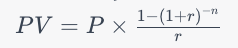
Where:
- PV is the present value of the annuity.
- P represents the periodic payment (annuity payment).
- r is the interest rate per period (expressed as a decimal).
- n denotes the number of periods.
Simply plug in your values for P, r, and n to unveil the present value.
C. Insights into the Formula for Annuities Due
For annuities due, where payments are made at the beginning of each period, the formula is slightly tweaked. Essentially, you’d calculate the present value as with ordinary annuities and then multiply the result by (1+r), accounting for the immediate payment.
6. Practical Scenarios: Using the Present Value of Annuity Calculator
A. Planning for Retirement with Annuities
Retirement planning is akin to piecing together a jigsaw puzzle. Each piece, from your savings to your investments, plays a crucial role. Annuities emerge as a cornerstone in this setup. By understanding the present value of your money, you can gauge how much you need to invest today to ensure a steady stream of income in your retirement years.
As per Investopedia, the present value denotes the sum of money required in your account now to cover upcoming costs or a sequence of future monetary outflows, considering a particular return rate.
B. Making Informed Financial Decisions with the Calculator’s Insights
The beauty of the present value of annuity calculator lies in its ability to offer insights tailored to your unique financial situation. Let’s say you wish to guarantee a monthly income of $2,000 in retirement, atop your Social Security income.
Opting for a conservative investment like an annuity, growing at 3.5% annually, would require a present value deposit of $456,858 today to ensure this monthly payout for 30 years, as highlighted by The Balance.
Such insights empower you to make decisions that align with your risk appetite and life expectancy.
7. Tips and Tricks for Effective Use of the Calculator

Ah, the allure of financial calculators! They promise precision, clarity, and insights into our financial futures. But like any tool, the present value of annuity calculator is only as effective as the hands that wield it. Let’s embark on a journey to master this tool, ensuring your financial decisions are both informed and strategic.
A. Importance of Accurate Input Data
Imagine setting off on a road trip with a faulty GPS; you’d end up lost! Similarly, inputting inaccurate data into your calculator can lead you astray. Always double-check your figures. Remember, garbage in, garbage out. Accurate inputs ensure reliable outputs, guiding you towards sound financial decisions.
B. Interpreting Results to Make Strategic Decisions
Once you’ve crunched the numbers, it’s time to interpret. What does the present value tell you about your future? Is it in line with your retirement goals? Dive deep into the results, understanding the implications and adjusting your financial strategies accordingly.
C. Common Pitfalls to Avoid When Using the Calculator
Beware of common mistakes. For instance, confusing ordinary annuities with annuities due can skew results. Also, overlooking the impact of inflation can paint an overly rosy picture. Stay vigilant, educate yourself, and avoid these pitfalls.
While the present value of annuity calculator is a powerful ally, it requires careful handling. Equip yourself with knowledge, approach with caution, and let this tool illuminate your financial path.
8. Real-world Testimonials: Success Stories with Annuities
Ah, the power of a personal story! Nothing resonates more with readers than real-life experiences. Let’s dive into the tales of Jack and Jill, two individuals who harnessed the power of annuities to secure their financial futures.
A. How Jack Optimized His Retirement with the Present Value Formula
Jack, a diligent saver, always dreamt of a serene retirement by the beach. But with the fluctuating markets and the uncertainty of life, he was unsure if his savings would suffice. Enter the present value of annuity calculator.
By understanding the present value of his future annuity payments, Jack could visualize his financial future. With a few tweaks here and there, he optimized his investments, ensuring a steady income stream. Today, Jack enjoys sunsets by the beach, all thanks to the foresight provided by the calculator.
B. Jill’s Journey: From Understanding to Effectively Using Annuities
Jill, unlike Jack, was new to the world of financial planning. The myriad of terms and calculations overwhelmed her. But her determination led her to the annuity calculator. With each use, she began to grasp the nuances of annuities. She learned the difference between ordinary annuities and annuities due, and how present value played a pivotal role in her financial decisions. Fast forward to today, Jill confidently navigates her financial landscape, making informed decisions that align with her retirement goals.
These stories underscore the transformative power of understanding and effectively using annuities. Whether you’re a novice like Jill or a seasoned planner like Jack, the right tools and knowledge can pave the way for a secure financial future.
Conclusion
Navigating the financial waters of annuities can seem daunting, but with the right tools and understanding, it becomes a breeze. The annuity formula, a beacon in the fog, illuminates the path to deciphering future cash flow from a series of payments. Whether you’re considering monthly or annual payments, it’s crucial to grasp how cash flow, compounding, and the period of time interact in this dance of numbers. Remember, an insurance company isn’t just a fund manager; it’s a partner in securing your financial future. Whether it’s a loan or an investment, the annuity type you choose, and the time period you opt for, can significantly influence your returns. So, as you stand at the crossroads, pondering which path to tread, let the knowledge of annuities guide you. Dive deeper, ask questions, and engage with the content. Your financial future beckons, and it’s time to answer the call with informed decisions. Take action now, and harness the power of annuities to sculpt a secure tomorrow.
Frequently Asked Questions (FAQ)
What exactly is the present value of an annuity?
The present value of an annuity represents the current worth of a series of future payments, given a specific rate of return or discount rate. It’s a crucial concept rooted in the time value of money, emphasizing that a dollar today holds more purchasing power than a dollar in the future.
How does the discount rate impact the present value of an annuity?
The discount rate is pivotal in calculating the present value. It mirrors the time value of money, suggesting that today’s dollar is more valuable than a future one since it can be invested to potentially yield returns. A higher discount rate reduces the present value of the annuity, as future payments are more heavily discounted. Conversely, a lower rate increases the present value.
What’s the difference between the present value and future value of annuities?
While the present value offers insight into the current worth of future annuity payments, the future value projects the worth of those payments at a later date, considering factors like compounding and interest.
How do annuity payments differ from lump sum payments?
Annuity payments are a series of payments made over a set period of time, while a lump sum is a one-time payment. Understanding the present value of an annuity allows individuals to compare the potential value of receiving a series of payments in the future versus a lump sum payment now.
Are there tools available to help calculate the present value of an annuity?
Absolutely! There are online calculators and mathematical formulas designed to help individuals determine the present value of an annuity. These tools consider factors like payment amount, interest rate, and the number of payment periods.
